Field note 005 · Thaw + stage
Choose the thawing line before dinner depends on it.
A frozen package needs a route, a finish time, and a clean landing zone. Use the refrigerator when you can plan ahead; use cold water or the microwave only when the cook step can start immediately.
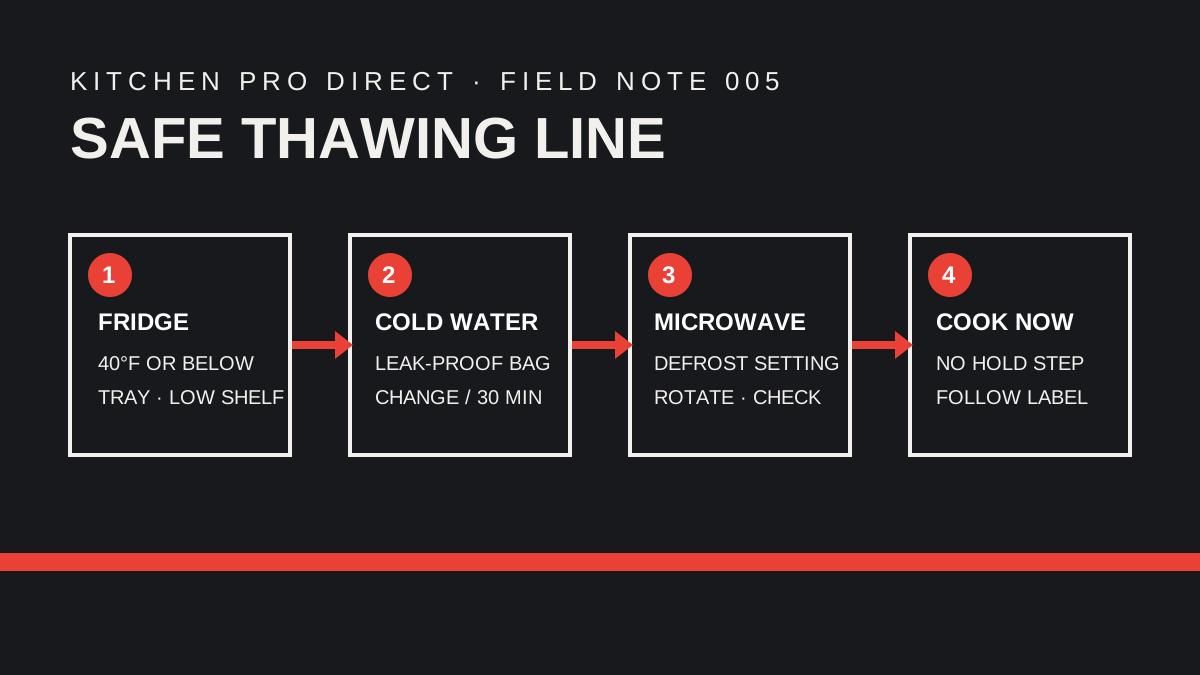
Do not thaw perishable food on the counter, in hot water, outdoors, in a garage, or in a car. USDA identifies three safe thawing methods: refrigerator, cold water, and microwave. Cold-water and microwave routes end at the stove, oven, or other cook step—not at an overnight holding step.
Start with the deadline, not the package
Thawing is easy to postpone because the food appears unchanged for hours. The better question is not “When should I take this out?” but “When must the center be thawed, and what must happen next?” Work backward from the cook time. Include preparation, seasoning, preheating, and the possibility that a thick center needs more time than the package estimate.
USDA’s consumer guidance explains why the route matters: frozen food stays safe indefinitely, but bacteria present before freezing can multiply as the surface warms above 40°F. A roast can still feel frozen at its core while its outer layer sits in a warmer range. The counter is therefore not a controlled shortcut.
Refrigerator
Slow and low-attention. Best when the finish time can be estimated a day or more ahead.
Cold water
Faster, hands-on, and dependent on leak-proof packaging plus 30-minute water changes.
Microwave
Fastest, but uneven warming means cooking must begin immediately.
From frozen
Possible for many foods, with longer cook time; product-specific directions still control.
A written route eliminates the most common late change: beginning with cold water, finishing earlier than expected, then asking whether the food can wait until tomorrow. Public discussion repeatedly shows this planning gap around holiday birds. USDA’s instruction is direct: cook food immediately after a cold-water or microwave thaw.
Build the refrigerator line around containment
Refrigerator thawing is the default when time allows because the food remains in a controlled cold zone throughout the process. Verify the appliance holds 40°F or below with an appliance thermometer. Put the wrapped food in a rimmed pan or container that can hold a leak, then place it low enough that raw juices cannot drip onto ready-to-eat food.
- Read the label. Keep any thawing or cook-from-frozen directions with the package.
- Estimate the finish. Small items may thaw overnight; many foods need one or two days. Allow roughly one day per five pounds for a large turkey.
- Contain the package. Use a clean rimmed tray with enough capacity for purge and condensation.
- Clear a low shelf. Keep produce, cooked food, and uncovered ready-to-eat items outside the leak path.
- Label the move. Record the date and intended cook time so the package does not become an undated refrigerator resident.
- Check the center early. If it remains icy near the deadline, choose a controlled recovery route while there is still time.
Food thawed in the refrigerator can generally be refrozen without cooking, although moisture loss may reduce quality. That flexibility belongs specifically to the refrigerator route. Do not transfer the same assumption to food thawed in cold water or a microwave.
A crowded refrigerator can slow the work and obscure leaks. Leave space for cold air to circulate and avoid the door, where temperature changes with every opening. The container is a process control, not a serving dish: wash and sanitize it after the raw package leaves.
Run the cold-water line on a 30-minute clock
Cold-water thawing trades calendar time for active attention. Seal the food in a leak-proof package or bag, fully submerge it in cold tap water, and change the water every 30 minutes. The replacement water keeps the bath cold and continues heat transfer. USDA warns that a leaking bag can admit environmental bacteria and make the food absorb water.
Use a vessel large enough for the food without forcing it against a sharp edge. Set a repeating timer when the package enters the bath. Each alarm is a work order: drain, refill with cold tap water, inspect the seal, and confirm the package remains submerged. Do not substitute warm or hot water to “catch up.”
A whole turkey provides useful planning math. A 12-pound bird takes roughly six hours by the cold-water estimate; a 20-pound bird takes about ten. That is an attended shift, not an overnight passive method. If the calculated finish falls after the kitchen closes, choose refrigerator thawing earlier or move the meal plan.
Once thawed, move directly into preparation and cooking. Do not use cold water to finish a bird tonight for dry brining tomorrow. If a recipe needs refrigerated seasoning time, that time belongs after a refrigerator thaw and must fit within current food-safety guidance.
Reserve the microwave line for an immediate handoff
Microwave energy can warm thin edges while the center remains icy. USDA says those warm areas may begin to cook, which is why the next step must be full cooking. Before defrosting, remove packaging that is not microwave safe and transfer the food to a suitable dish.
- Confirm fit. The food and dish must rotate freely if the oven uses a turntable.
- Use the defrost control and weight input. Follow the appliance manual and food label.
- Pause, rotate, and separate. Break apart pieces as soon as they release so energy reaches them more evenly.
- Shield only as directed. Never improvise with packaging or metal that the manufacturer does not allow.
- Move straight to cooking. The microwave is the first stage of the cook line, not a holding station.
This route works best for smaller, fairly uniform portions. A large bird or thick roast may not fit, rotate, or thaw evenly. When the equipment cannot perform the job described in its manual, use the refrigerator or a properly managed cold-water bath.
Know when cooking from frozen is the cleaner plan
USDA says raw or cooked meat, poultry, and casseroles can often be cooked from frozen, with roughly one-and-a-half times the usual cooking time. That can be more controlled than a rushed thaw, but it is not a universal override. Read the product label. Some commercially prepared items must be cooked from frozen, while others require thawing or a specific appliance.
Remove wrapping and absorbent pads as soon as the directions allow. For a whole frozen bird, remove the giblet packet once it loosens and cook it separately. Use a food thermometer and the current safe final-temperature guidance for the specific food; extra time alone does not prove that the center is done.
Plan capacity before using this route. A longer cook can collide with side dishes, oven sharing, and serving time. Record the expected extended window and leave a buffer for thermometer checks and resting. The digital scale audit can help verify portion weights when timing instructions depend on mass.
Turn turkey weight into a schedule
FoodSafety.gov advises about 24 hours of refrigerator thawing for every 4 to 5 pounds, or about 30 minutes per pound in cold water. These are planning estimates, so start refrigerator thawing early and retain a buffer. A 20-pound turkey needs about four to five days in the refrigerator.
| Weight | Refrigerator at 40°F or below | Cold water |
|---|---|---|
| 4–12 lb | 1–3 days | 2–6 hours |
| 12–16 lb | 3–4 days | 6–8 hours |
| 16–20 lb | 4–5 days | 8–10 hours |
| 20–24 lb | 5–6 days | 10–12 hours |
For the refrigerator route, keep the bird wrapped on a rimmed tray. For cold water, keep it in leak-proof packaging, completely submerged, change the water every 30 minutes, and cook immediately. Do not plan a cold-water thaw that ends hours before the oven is available.
The schedule should also include the raw-prep zone. A large bird occupies sink and counter space, produces packaging and juices, and can cross paths with salads, bread, or garnishes. Use the two-board prep station to keep raw work physically separate from ready-to-eat work.
Stage the handoff before opening the package
The thawing line is complete only when the next station is ready. Clear the work surface, remove ready-to-eat food, set out a waste container, wash hands, and confirm the cooking vessel is available. Keep a clean food thermometer within reach without placing it in the raw zone.
- Refrigerator thermometer reads 40°F or below.
- Rimmed tray or leak-proof bag fits the food.
- Cold-water vessel can be drained safely without splashing other dishes.
- Repeating 30-minute timer is audible from the working area.
- Microwave-safe dish and manufacturer instructions are available.
- Cookware, oven space, and thermometer are ready at the thaw finish.
- Raw-contact sink, tray, handles, and work surfaces have a cleaning plan.
After handling raw meat or poultry, wash hands with soap and warm water for 20 seconds. Wash the cutting board, knife, counter, sink contact points, and other tools with hot soapy water, then apply the appropriate sanitation procedure. Do not rinse raw poultry; splashing spreads contamination around the sink and nearby surfaces.
If the thawed food becomes part of a large batch, finish the workflow with the batch-cooling line: divide leftovers into shallow containers and refrigerate within the applicable time limit.
Audit the handoff, not just the thaw
A successful thaw is one that arrives at a staffed cook station on schedule. Record one real run and improve the constraint that caused the most friction.
Thawing line record
____Route
____Start
____Target
____Actual finish
____Cook start
____
If refrigerator thawing ran late, check whether the weight estimate, shelf location, refrigerator temperature, or starting state was wrong. If cold-water work became exhausting, the batch was too large for that active method. If the microwave created cooked edges, reduce portion size or choose another route next time.
Do not convert a missed schedule into a counter thaw. Change the menu, cook an item that can safely start frozen according to its label, or use a controlled method that still fits the remaining time. The objective is a reliable meal, not rescuing the original timeline at any cost.
Frequently asked questions
What are the three safe ways to thaw frozen food?
USDA identifies the refrigerator, cold water, and microwave. Food thawed in cold water or a microwave should be cooked immediately.
Can I leave frozen meat on the counter for a few hours?
No. The exterior can warm above 40°F while the center remains frozen. Use one of the controlled methods.
Can I refreeze food after thawing?
Food thawed in the refrigerator can generally be refrozen without cooking, although quality may decline. Food thawed in cold water or a microwave should be cooked before refreezing.
How do I recover when a turkey is still icy?
If there is enough attended time, finish with the cold-water method and cook immediately. Otherwise follow label-supported cook-from-frozen guidance or adjust the meal schedule. Do not use warm water or the counter.
Sources checked
- USDA Food Safety and Inspection Service — Freezing and Food Safety.
- USDA FSIS — How do you thaw food safely?, updated September 18, 2024.
- USDA FSIS — Keep Food Safe! Food Safety Basics.
- U.S. Food and Drug Administration — Food Safety Tips for Healthy Holidays.
- FoodSafety.gov consumer resources and Turkey Thawing Calculator guidance.
Research reviewed October 20, 2026. Public discussions were used to identify recurring planning questions; safety instructions come from the primary government sources above. This home-kitchen guide follows consumer guidance; food businesses must follow their applicable food code and regulator.