Field note 006 · Holiday cold line
Organize the Thanksgiving refrigerator before it becomes the bottleneck.
The refrigerator is a production station, not overflow storage. Give the turkey a contained low shelf, protect ready-to-eat food, leave room for cold air, label the make-ahead queue, and hold an empty landing zone for leftovers.
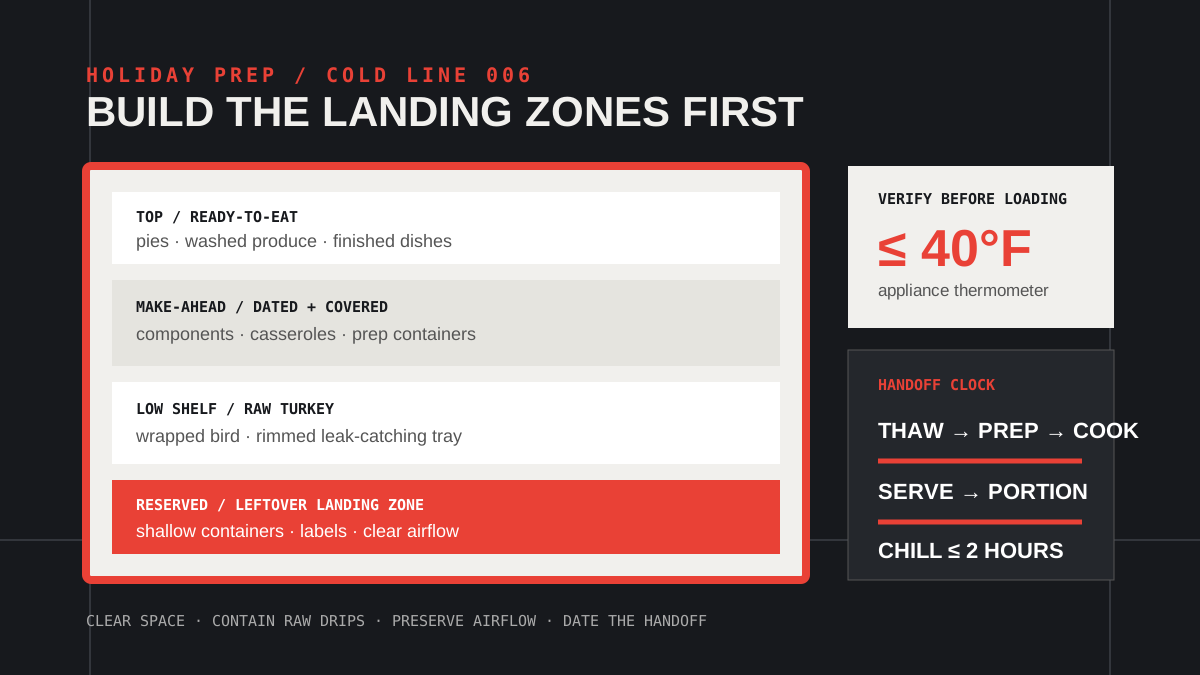
Keep the refrigerator at 40°F or below and the freezer at 0°F. Do not pack the cabinet so tightly that cold air cannot circulate. Raw poultry belongs contained and below foods that will be served without further cooking. Refrigerate perishable leftovers within two hours.
Start with cubic inches and deadlines
Holiday refrigerator trouble usually appears as a space problem, but it begins as a scheduling problem. A wrapped turkey needs several days of cold storage. Make-ahead dishes arrive in wide pans. Drinks occupy the door and every open ledge. Then the finished meal produces more food than the refrigerator was asked to hold at any earlier point. If the cabinet has no reserved landing space, hot leftovers wait while containers are found and old food is moved.
Map the cold line before shopping. Record the turkey’s packaged dimensions, the rimmed tray beneath it, the number and footprint of make-ahead dishes, and the shallow containers planned for leftovers. Include height, not only shelf area. A roasting pan may fit through the door but collide with a shelf rail; a stacked casserole may block the supply vent; a tall turkey can force ready-to-eat dishes down into the raw-food leak path.
The operating limit is temperature, not visual neatness. FDA advises holding the refrigerator at 40°F or below and avoiding overpacking so cold air can circulate. Put a freestanding appliance thermometer where it can be read without dismantling the load. The control dial is a setting, not a temperature report. Check the thermometer before the holiday groceries arrive, after the cabinet is loaded, and again during the busiest prep day.
Public holiday-cooking discussions repeatedly return to the same constraints: no room for the thawing bird, Wednesday prep pans replacing everyday food, mismatched containers after dinner, and a refrigerator packed before leftovers exist. Those reports are useful for finding workflow failures. The safety controls in this guide come from FDA, USDA, FoodSafety.gov, and Extension guidance.
Run the refrigerator audit about a week ahead
Nebraska Extension’s current Thanksgiving guidance recommends cleaning out the refrigerator the week before an event to make room for thawing items and leftovers. Treat that as a production audit rather than a permission slip to discard everything. The goal is to identify what must be used, frozen, consolidated, or safely moved before the holiday load arrives.
- Read the thermometer. Confirm the refrigerator is at 40°F or below and the freezer is at 0°F. If the reading is high, solve the temperature problem before adding a large bird.
- List every dated container. Identify leftovers, opened foods, and produce that already have a near-term use. Plan ordinary meals around suitable food rather than creating more leftovers.
- Check storage guidance. Package dates are not universal safety timers. Use the applicable product instructions and current government storage chart for the food.
- Consolidate carefully. Combine only identical foods with compatible dates and histories. Label the resulting container with the earlier date.
- Remove empty packaging. Large boxes and retail trays can consume useful volume, but keep required directions, lot information, ingredient labels, allergen information, and safe-handling instructions with the food.
- Clean spills. Wash removable parts according to the appliance manual and wipe up old drips. A clean low shelf makes a new raw-poultry leak easier to see and contain.
- Dry and reset. Return food promptly, preserve airflow, and mark the shelves that are reserved for the turkey and leftovers.
Do not move perishable food to a garage, porch, vehicle, unmonitored cooler, or outdoor table merely because the weather feels cold. Outdoor temperature fluctuates, sunlight warms containers, animals gain access, and “cold outside” does not verify that food remains at 40°F or below. A cooler can be part of a controlled plan only when it has enough ice or frozen gel packs and a thermometer confirms safe cold holding.
Avoid turning cleanup into a long open-door session. Set a temporary cold holding area first, work one shelf at a time, and return food quickly. If the refrigerator cannot maintain temperature when normally loaded, reorganizing does not repair the appliance.
Build five zones around contamination and handoffs
A professional prep line reduces crossing paths. The home refrigerator can do the same when each shelf has a job. The exact shelf geometry differs by appliance, so use the hierarchy rather than copying a photograph.
Ready to eat
Washed produce, desserts, garnishes, and finished food that will receive no additional kill step. Keep covered and away from raw drips.
Make ahead
Dated, covered components and casseroles. Arrange by next use so the earliest handoff is not buried.
Raw ingredients
Eggs in their carton and other raw items, separated according to their risk and eventual cooking step.
Turkey bay
The wrapped bird in a rimmed, leak-catching tray on a low shelf where nothing ready to eat sits below it.
Leftover landing
Empty, reserved space sized for shallow covered containers after the meal. Keep labels and marker nearby.
Stable condiments
Use the warmer, frequently opened door for suitable condiments rather than eggs or the turkey.
FDA says to separate raw meat, poultry, seafood, and eggs from other foods in the shopping cart, bags, and refrigerator. Storage should continue the separation already established during shopping. A sealed retail wrapper is not a leak tray. A large bird can release liquid as it thaws, and a pinhole or loose seam may not appear until the shelf is crowded.
Keep every prepared item covered. Labels should answer three questions without opening the lid: what is it, when was it prepared or opened, and what is the next step? Add an allergen note when different versions of a dish share the refrigerator. A name such as “stuffing” is not enough if one pan is gluten-free or contains nuts.
Arrange the queue by handoff, not by container beauty. Food needed Wednesday afternoon should remain reachable even when the turkey occupies the bottom shelf. A simple strip of removable tape on the shelf edge can mark “Turkey tray,” “Thursday cold dishes,” and “Leftover landing.” The map prevents another household member from filling intentionally empty space with drinks.
Reserve the turkey bay before thawing starts
USDA identifies refrigerator thawing as the best plan-ahead route and advises roughly 24 hours for every four to five pounds. A 20-pound turkey therefore needs about four to five days in the refrigerator, and refrigerator-thawed turkey can remain there one to two days before cooking. The safe window still requires an appliance holding 40°F or below.
Measure the packaged bird while it is frozen, then choose a rimmed pan or food-safe container that can catch a full leak without flexing during removal. Test the loaded tray’s path through the refrigerator door. Place it on a low shelf, below ready-to-eat food, without blocking vents. Keep the original label and safe-handling instructions attached or immediately available.
Do not wash raw turkey. FDA warns that rinsing raw meat and poultry makes it more likely bacteria will spread around the sink and counters. Move the bird from contained cold storage to a cleared raw-prep station. Have the waste bin, paper towels or cleanable cloths, utensils, roasting equipment, and handwashing path ready before the package opens.
If refrigerator time is short, use only an approved recovery route. The safe-thawing workflow covers refrigerator, cold-water, microwave, and cook-from-frozen decisions. Cold-water and microwave thawing require an immediate cooking handoff. They do not create another make-ahead holding window.
| Packaged weight | Estimated thaw time | Cold-line action |
|---|---|---|
| 4–12 lb | 1–3 days | Clear the tray bay before the first thaw day. |
| 12–16 lb | 3–4 days | Verify the make-ahead queue can coexist for several days. |
| 16–20 lb | 4–5 days | Measure shelf height and preserve a low, contained position. |
| 20–24 lb | 5–6 days | Begin early; do not trade containment or airflow for a tight fit. |
Queue make-ahead food by next action
Preparing food a day ahead can simplify the holiday, as Nebraska Extension notes, but every prepared dish becomes a cold-storage job. Before making it, assign its container, shelf, label, reheating vessel, and removal time. Otherwise a labor-saving recipe can become an unplanned deep pan that blocks the refrigerator.
Use shallow, stackable containers when the food and recipe allow, but never stack warm containers so tightly that cooling is slowed. Keep covers secure and follow recipe-specific storage instructions. Pumpkin and pecan pies, casseroles with eggs, soups, stews, and many cooked dishes have time limits in the government cold-storage chart; “made ahead” does not mean “good through the weekend” without a date.
- Label the dish name, preparation date, and intended cook or reheat step.
- Mark common allergens when more than one version shares the refrigerator.
- Keep raw ingredients away from finished food and garnishes.
- Do not place a warm, deep stockpot into the reserved leftover space and assume the center will cool quickly.
- Store food in the vessel that best supports safe chilling, then transfer for serving if needed.
- Keep the door closed between planned pulls rather than browsing for the next task.
Build a pull list for Thanksgiving morning. Remove only what the current station can process. Returning a perishable casserole to the refrigerator after it sat through unrelated prep adds ambiguity. A dated schedule makes each handoff visible: refrigerator to counter, counter to oven, oven to service, service to shallow leftover container.
The two-board prep station keeps raw work separate from produce and ready-to-eat work. Use the five-point scale audit when portion weights control batch size or container count.
Stage the leftover landing before guests arrive
FoodSafety.gov says leftovers should be stored within two hours of cooking. Divide them into smaller portions and place them in covered shallow containers so they cool quickly. A whole turkey or large, deep container takes too long to cool. FDA makes the same point: hot food does not harm the refrigerator, and waiting for it to cool at room temperature consumes the safety window.
Before service, set out clean shallow containers and match each one with a lid. Put removable labels and a marker beside the packing station. Reserve actual refrigerator space, not a promise to “figure it out later.” If guests will take food, ask them to bring clean suitable containers or supply them yourself. Perishable food traveling more than two hours needs controlled cold transport with ice or frozen gel packs.
- Start the clock. Know when each perishable dish left controlled hot or cold holding.
- Carve and portion. Remove usable meat from the turkey rather than refrigerating the whole carcass as one warm mass.
- Divide deep foods. Move gravy, stuffing, casseroles, and other dense foods into smaller, shallow covered containers.
- Label immediately. Record the dish and date before containers become visually similar.
- Load the landing zone. Leave gaps for airflow and avoid placing every warm container in one tight stack.
- Set the use-or-freeze deadline. Most cooked leftovers keep three to four days in the refrigerator at 40°F or below.
For the 2026 Thanksgiving calendar, a meal served Thursday, November 26 reaches the end of the usual three-to-four-day refrigerator window around Sunday or Monday, depending on the food and storage timing. Check the specific dish in FoodSafety.gov’s cold-storage chart and freeze suitable portions earlier if they will not be used. The batch-cooling line explains shallow-container cooling for soups, chili, and other dense foods.
Smell and appearance cannot prove safety. Labeling and time control do more than a weekend sniff test. Reheat leftovers to 165°F; FoodSafety.gov also advises bringing sauces, soups, and gravies to a rolling boil during reheating.
Make a small refrigerator more predictable
A smaller refrigerator does not need a novelty organizer as much as it needs fewer simultaneous jobs. Reduce the menu before defeating airflow. Choose dishes that can safely remain shelf-stable before opening, use the freezer strategically in advance, and delegate foods that arrive ready for service without requiring hours of refrigerator staging.
Move beverages only to a genuinely controlled alternative. A cooler with ice can keep sealed drinks out of the primary cabinet, but drinks do not need to displace raw turkey containment or leftover space. Keep a separate food cooler if opening the drink cooler repeatedly would compromise perishable food. Monitor temperature rather than assuming a bag of ice solves the entire day.
Wide serving bowls are inefficient storage vessels. Chill food in covered containers sized for the refrigerator and transfer it to serving ware at the handoff. Nest empty serving pieces outside the cold line and place a note inside each naming the intended dish. This preserves refrigerator volume without losing the service plan.
If the menu still cannot fit while maintaining 40°F or below, airflow, containment, and safe time limits, the capacity plan has failed. Reduce batch size, choose a smaller bird, shift an appropriate dish to the freezer earlier, arrange verified cold holding, or change the menu. Do not solve a volume problem by leaving perishable food on the counter.
Use one cold-line record for the whole meal
A refrigerator map becomes useful when it survives the holiday rush. Put one record on the door or in the kitchen plan. It should show the thermometer reading, turkey start and cook dates, make-ahead labels, leftover container count, and the final use-or-freeze deadline.
Thanksgiving cold-line record
____Turkey in
____Turkey cook
____Prep pans
____Leftover tubs
____Use/freeze
____
Assign one person to manage the refrigerator during the final hour of service and cleanup. That person does not need to make every packing decision, but they should protect the landing zone, keep raw and ready-to-eat food separated, confirm lids and labels, and prevent the door from remaining open while everyone searches.
After the holiday, note which forecast was wrong. Did the turkey tray need more height? Did six make-ahead dishes arrive when four were planned? Were the shallow containers too large for the remaining shelf? Update the measurement record before the next large meal. A reliable cold line improves because the real constraints are preserved.
Frequently asked questions
How should I organize my refrigerator for Thanksgiving?
Verify 40°F or below, preserve cold-air circulation, keep ready-to-eat foods protected above raw poultry, contain the wrapped turkey on a rimmed tray on a low shelf, label make-ahead dishes, and reserve an empty landing zone for shallow leftover containers.
How early should I clean out the refrigerator?
Audit it about a week before the event, then verify space and temperature again before the turkey or make-ahead dishes arrive. Use, freeze, or discard food based on its actual history and applicable guidance—not merely to create an empty-looking shelf.
Can hot leftovers go directly into the refrigerator?
Yes. Divide large amounts into smaller, shallow covered containers and refrigerate within two hours. Do not leave a whole turkey or deep pot on the counter waiting to reach room temperature.
How long do Thanksgiving leftovers last?
Most cooked leftovers, including turkey, should be used within three to four days in a refrigerator holding 40°F or below, or frozen for longer storage. Check the specific food in the current government cold-storage chart.
Sources checked
- U.S. Food and Drug Administration — Refrigerator Thermometers: Cold Facts about Food Safety.
- U.S. Food and Drug Administration — Food Safety Tips for Healthy Holidays.
- USDA Food Safety and Inspection Service — What is the safest way to thaw a frozen turkey?, updated September 18, 2024.
- FoodSafety.gov — Thanksgiving Leftovers for Safe Keeping, Weekend Grazing.
- FoodSafety.gov — Cold Food Storage Chart, reviewed September 19, 2023.
- Nebraska Extension — Quick Tips for Thanksgiving Food Safety, peer reviewed and updated in 2025.
Research reviewed October 28, 2026. Public discussions were evaluated to identify recurring capacity and handoff problems; safety instructions come from the government and Extension sources above. This home-kitchen guide follows consumer guidance. Food businesses must follow their applicable food code and regulator.